40 houses7 neighborhoodsbuilt 1710–2016~2,480 studentsunofficial & fan-madeFAQscampus mapbus lines135 socials40 houses7 neighborhoodsbuilt 1710–2016~2,480 studentsunofficial & fan-madeFAQscampus mapbus lines135 socials

Smith College Houses

An unofficial guide to all 40 residential houses at Smith College in Northampton, Massachusetts — what each house is like, where it sits on campus, its socials, and the traditions that make it home. Built to help incoming Smithies and their parents make sense of the house system and choose where to live.
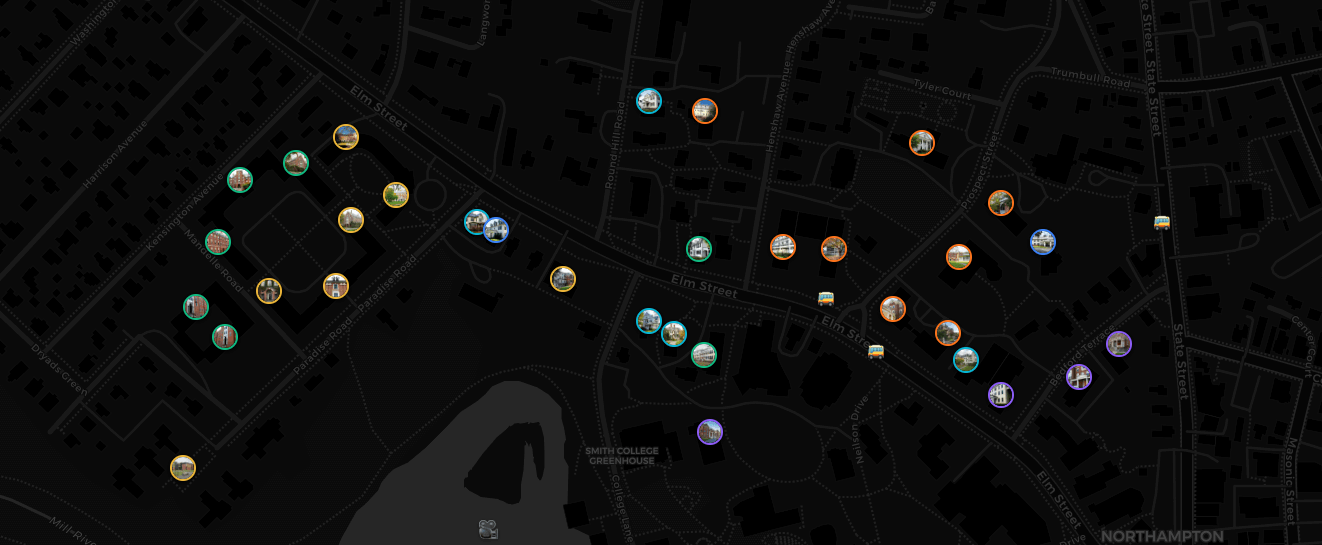
Map of all 40 Smith College houses on the Northampton campus Open the interactive campus map ›
40houses
7neighborhoods
1710–2016years built
~2,480students housed
38accessible

How Smith's house system works

Smith doesn't have traditional dorms. Students live in houses — self-governing communities where first-years through seniors live together, ranging from about 10 to 100 residents. Many are historic homes; each has its own character, student government, and traditions (house teas, study breaks, mascots), and a couple run their own student food co-ops. There are no first-year dorms, so new students settle straight into house life alongside returning students.

The 7 neighborhoods

See all 40 houses, by neighborhood →

Traditions & lore

Every house has its own personality. A few favorites:

More lore →

Frequently asked questions

What is Smith's house system, and how is it different from a dorm?
Instead of conventional dorms, Smith students live in self-governing houses — communities of roughly 10 to 100 residents. Each house has all four class years living together, its own house government and traditions, and often its own dining room; many are historic homes rather than large residence halls. (Smith Residence Life)
Do first-years live separately from upperclass students?
No — Smith has no first-year dorms. Every house mixes first-years through seniors, so new students live alongside returning ones from day one. (Her Campus housing guide)
How many houses are there, and what are the neighborhoods?
This guide covers 40 residence houses across 7 neighborhoods: Garden, Ivy, Mountain, Paradise, Meadow, River (Ada), River (Graduate). You can browse them all by neighborhood or see them on the campus map.
Which houses are food co-ops?
Two houses currently run student food cooperatives, where members buy groceries and cook together: Tenney and Hopkins (whose residents call themselves the “Hopkids”). Lawrence House pioneered cooperative living at Smith back in 1912. (The Sophian)
Are the houses accessible?
Smith lists 38 of the 40 houses as having an accessible first floor — every house except Lee House and 44 Green Street. That is a narrower claim than step-free access throughout: 12 houses have an elevator. Check each house's page for its specifics, or see them highlighted on the campus map.
How do students choose or get placed in a house?
Incoming students rank the neighborhoods they'd prefer and are placed by Residence Life; returning students take part in an annual room-draw and house-change process. The details shift year to year, so confirm current specifics with Smith's Residence Life office.

More questions →

Why this site exists

This started when our own family faced Smith's house-selection process and found it bewildering — dozens of houses, a system unlike a typical dorm, and scattered Instagram accounts, with little in one place to compare them. It began as a simple campus map and a list of every house's Instagram, then grew into a fuller guide: photos, stats, locations, namesakes, and lore.

It's made for new students and parents getting their bearings. It's unofficial and fan-made — not affiliated with Smith College. Comments/Questions/Complaints/Suggestions? Email [email protected]

Browse the house socials directory →